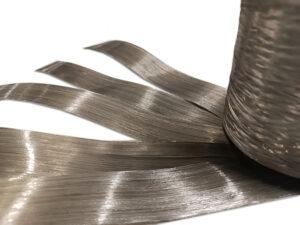
AluBas Tape: High-performance composite tape product combining design and integrated functionality
The companies FibreCoat and A+ Composites, both nominated for the CAMX Award 2025, present AluBas Tape: a cutting-edge technical tape with high-performance functionality. AluBas represents a new approach to material design – where premium appearance and precise technical performance are united in a single lightweight product.
The tape is the result of a close development partnership: FibreCoat contributed the functional core with its AluBas fibers – aluminum-coated basalt fibers delivering exceptional electrical and thermal conductivity. A+ Composites led the further processing, using advanced fibre spreading technology, and industrial upscaling into a market-ready high-performance composite tape product.
Design meets performance – a material of distinction
With its metallic-textured, embossed surface, AluBas transforms technical components into visually refined elements that stand apart from conventional tapes. Beyond its distinctive look, the integration of AluBas fibers equips the tape with advanced technical capabilities, including:
- Effective (EMI) shielding to protect sensitive electronics
- Thermal management for improved system reliability
- Easy to integrate & lightweight thermoplastic material
This combination of visual refinement and advanced functionality opens up entirely new application areas – anywhere technical surfaces must not only perform but also contribute to a product’s design language. “AluBas Tape brings together technical and design demands – offering a material that inspires in the design process and integrates efficiently into industrial production,” explains Markus Brzeski, Managing Director of A+ Composites.
Design freedom through material intelligence
AluBas was developed for a new era in material science – where visible technology becomes a deliberate design element. Its unique surface structure transforms it into a design-capable material that enables both visual differentiation and technical integration – ideal for developers who no longer want to choose between form and function. “Our mission was to develop a material that combines technical performance and luxurious surface in a single tape. AluBas is the realization of that vision,” says Robert Brüll, CEO of FibreCoat.
Industrial scalability and process compatibility
AluBas Tape can be seamlessly integrated into existing manufacturing processes. It combines technical functionality with economic processability, often replacing complex multilayer constructions with one high-performance solution.
Request samples or discuss your project now
Companies, developers, and designers interested in integrating AluBas can now request samples or discuss custom applications with the development teams at FibreCoat and A+ Composites.
For more technical details and contact options, visit: www.fibrecoat.de or www.aplus-composites.de.

FibreCoat named one of Fast Company’s Best Workplaces for Innovators
FibreCoat, a world leader in the development and production of advanced coated fibres, has been named one of Fast Company’s Best Workplaces for Innovators for 2025.
The prestigious list honours organisations from around the globe that, from open collaboration to cross-disciplinary problem-solving, successfully create the conditions for innovation and support employees turning ambitious ideas into groundbreaking products and services.
FibreCoat’s materials combine the properties of metals and fibres, offering lightweight, ultra-resilient solutions for applications in mobility, construction, aerospace, and beyond. Founded in Germany in 2020 and now operating production sites in Aachen, Rustavi (Georgia), and Gorlice (Poland), the company has pioneered a novel technology to coat metals and plastics onto fibres during the fibre-spinning process.
This approach combines the strength and flexibility of fibres with the functional properties of the coating material, unlocking applications in electromagnetic shielding, thermal protection, and structural reinforcement.
Over the past year, FibreCoat, which employs around 42 members of staff, has launched a number of industry-first products including a radar-absorbing composite for stealth applications and cost-efficient conductive fibres for EV and satellite markets. These advances were made possible thanks to the company’s collaborative, high-trust culture, where engineers, scientists, and production teams are encouraged to pursue ideas and test new approaches quickly.
One of the clearest examples of how the culture breeds innovation can be seen in the development of FibreCoat’s own in-house spinning line, a project initiated by a former student employee who has since grown to lead the company’s R&D department.
The project drew on ideas from across the company: the original in-house build proposal came from one employee, a modular container design from another, a new feeding system from a third, and an innovative coating method from a fourth. This open, bottom-up approach has already drawn global attention.
Dr Robert Brüll, CEO of FibreCoat, said:
‘We often speak of innovation as if it simply happens by itself. But it comes from people. My senior team and I have worked hard to develop the kind of culture where anyone can speak up, challenge assumptions, experiment, and push for higher standards. The in-house spinning line is a perfect example: it began as one person’s idea, grew through contributions from across the team, and is now a key strategic advantage for us. Being recognised by Fast Company is an honour. But it also confirms something we already knew: that our people are our greatest asset.’
Unlike many manufacturing companies, FibreCoat has embedded innovation into every layer of its operations. The flat organisational structure accelerates decision-making, individuals are trusted to make sound decisions, and the company actively removes barriers to experimentation and friction of all kinds.
It’s thanks to this culture that young talent, often drawn from RWTH Aachen and FH Aachen, can take ownership of high-impact projects and make breakthroughs.
FibreCoat’s materials, which are lightweight, cost-effective, high-performance and have widespread applications, have proven themselves in a number of industries, and are now being viewed as a key solution to problems faced by the space sector. Spacecraft, from launchers to satellites, must withstand harsh conditions, including intense radiation, extreme temperatures, and electromagnetic interference (EMI). They must also be as lightweight as possible for reasons of efficiency and cost-effectiveness.
The World Economic Forum has predicted that the global space ecosystem will reach $1.8 trillion in value by 2035, in part due to growing demand for space-enabled services across the global economy.
The Fast Company list is compiled through a competitive selection process that evaluates companies on measurable innovation outcomes, investment in research and development, and employee empowerment. This year’s honourees include leading multinationals, start-ups, and non-profits across industries ranging from technology to healthcare.

FibreCoat develops new ‘stealth’ fibre-reinforced composite, capable of making assets invisible to radar
FibreCoat, a world leader in materials technology, has developed a groundbreaking fibre-reinforced composite capable of making aircraft, tanks and spacecraft invisible to radar.
The company, founded in Germany in 2020 but developing its materials since 2014, is known for inventing a novel technology to coat metals and plastics onto fibres, thus combining the properties of the fibres and the coating material, during the fibre-spinning process.
The new fibre-reinforced composite – still at the proof-of-concept stage – goes beyond traditional radar-shielding technology. Where existing solutions rely on reflecting radar waves, FibreCoat’s fibre reinforced composite, a thin and flexible radar absorbing material (RAM), absorbs them. It uses bicomponent multifilament yarn dispersed in composites and is made from carefully engineered blends of PMMA, carbon nanotubes, and Alucoat fillers. These are tuned for precise thicknesses (ranging from 0.5 mm to 6 mm) and for key radar frequency bands such as the X-band (8–12 GHz).
It is a major leap forward that increases the number of possible applications, from military stealth to electronic protection. The RAM has achieved reflection losses of up to -40 dB, equivalent to 99.99% radar absorption – making it among the most effective RAMs available today.
Unlike many stealth solutions that degrade at angle, FibreCoat’s multilayer composites maintain performance across curved surfaces and slanted radar exposure. In testing, they have achieved ≥ -10 dB reflection loss up to 60° in Transverse Electric (TE) mode and up to 45° in Transverse Magnetic (TM) mode.
Current stealth technology typically requires thick plating or specialised paints. Rival materials are narrow-band, so targeting a single radar frequency. FibreCoat’s solution, in contrast, is lightweight, flexible, and broadband: absorbing radar across a wide spectrum of frequencies and outperforming existing materials by up to 100 times.
The fibre-reinforced composite, a type of ‘meta-material’, is soon to be commercially available. The company has completed successful laboratory tests and measurements, and expects field testing to be complete this year. FibreCoat may offer the fibre to partners for integration into final products.
Dr Robert Brüll, CEO of FibreCoat, said:
‘This is a leap forward. We’re moving stealth technology beyond the limits imposed by needing to reflect, rather than absorb radar waves.”
The stealth technology market is a critical part of the defence sector. At a time of geopolitical unrest, there is surging demand for materials that do more without adding weight, complexity or cost.
FibreCoat’s range of products offer strength, conductivity, shielding, and recyclability at a fraction of the weight and cost of their competitor products. FibreCoat now employs 42 members of staff and has three production sites: Aachen, Germany; Rustavi, Georgia; and Gorlice, Poland.
by Composites in Manufacturing